Poetry has been around for 5,000 years of recorded history. It’s amazing to look at where poetry has been and where it is going. The oldest poetry started out being sung and grew out of religious rituals. Poetry has a close connection with music. The Mesopotamian culture started it all with stories of gods and myths. The poetry was accompanied by harp or lyre, and was sung by bards or choirs, in the form of Epics or Ballads. The ancient Egyptians’ poetry spans 3 millennia and includes playful, flirtatious, personal poetry about attraction and courtship. There is also poetry from India, which includes religious hymns about deities and religious ideas from 2,000 years ago; that was the foundation of Hinduism and Buddhism. Here we see a strong tradition of female poets. India set the standards of literature and art. The Bible, written in 1,000 B.C., is made up of rich poetry and prose, and is still popular today. The Greek’s were known for the Epic poems; The Iliad and The Odyssey, which were ancient adventure texts written in poetry. Written in Latin, they set the standard for lyrics, creativity, and excellence for Western European countries. The Chinese poetic literature and culture in 1066 B.C. gave rise to Taoism. Confucius collected and edited ancient Chinese writings. The Dark Ages saw the Renaissance in which poetry, art, and music were a focus. It also saw a surge in creativity, and a fusion of Arabic, Japanese, and Chinese forms of verse and love poetry. Arabic poetry established sayings and idioms of Islamic law and life. Old English poetry is mostly written by “Anonymous”, and frequently has chivalrous tales as its base. Journals became popular to record poetry and prose in the 12th century. In the 14th century, arts and sciences, dramatic plays and lyrical epic poetry became popular. The Sonnet became the craze during the Renaissance. Finally, more recently, the age of Enlightenment in the 18th century saw a quest for clarity and perfection in poetry by conforming to set forms. Today’s poetry is flexible, not so rigid in form, and has an easy and comfortable feel to it. And that in a nutshell is the history of poetry.
Happy Poetry Day!
Swans Swoon
Swans swoon
On river, crystal blue
And gentle sounds
Of waterfalls
Sing softly
Thru the breeze,
Which fingers
The featherlike leaves
Of a weeping willow tree,
That tilts
Serenely
Over the sandy shore
Of the smoothly running
River, crystal blue.
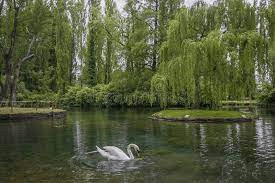
The peace of this scene allows us to experience nature’s beauty. The swan, ever a symbol of nobility and pride, starts as the ugly duckling from the story. The Willow Tree is symbolic of the wispiness of romance and tears of joy. Together, these elements blend in a tale of fantasy. There is the presence of the Muse in the telling of this poem.
Writing Exercise 8
Pretend you are stuck in the elevator. Is anyone with you? How long are you stuck for? What thoughts are going through your mind? Will you ever use the elevator again?
Poetry Is…17
The important thing when writing is to write about something you know about. Some topics that everyone has thoughts on include death, desire, and the nature of existence. Questions poetry answers are: Who are we? Why are we here? Where are we going? Remind yourself what you remember, what you imagine, what you wish, what you wonder, and what you want. You have your family, your community, and your history to draw from. Also, you have your daily experiences, your dreams, your convictions, and your loves about the world. Shared knowledge as individuals, as a culture, and a species, can also inspire you and can be written about. Memories, ideas, ethics, beliefs, and the spiritual are other common topics for poetry. The heart, the mind, and the spirit are all aspects that are apparent in poetry. Imagination is expressed through direct experience. The ordinary and the fantastic come together, in the mysterious world around you. Keep writing! It’s good for you!
Valentine’s Wish

Dragon’s Keep
Atop the mountain
In the craggy cliffs,
A red dragon sits,
Scanning the horizon.
It spreads its mighty wings
Once,
Twice,
And with a baring of
Its golden scaled breastplate,
And raising its
Pointed chin
To the sky,
Gracefully it lurches
Into the wind currents.
Circling in the heavens,
It tastes the energy
In the air.
Eventually
Arriving at its roost,
It magnificently
Sinks down into
A comfortable bed
Of glittery
Trinkets and sorts.
Resting his majestic head
Onto its scaly, shimmery
Shoulder
It closes its
Timeless, ageless, and wise
Eyes
Into a century of
Patient waiting
For awakening…
The treasure is always protected by the Spirit of the Dragon. So, your spirit is also protected because it is the ultimate treasure. The greedy will try to capture it and corrupt it. That is why it is so important to live fiercely and with full knowledge of yourself. Be aware of who and what you let in your life. They can be deceptive and sly, and destroy your well-being. Always choose the light. Good people are everywhere and can help you through the darkness of life’s cave. Trinkets and lockets of your heart shine with the beauty of the light in your own soul. And remember, spirit watches over you. All you have to do is acknowledge. Enjoy the wildness of life while under the watchful eye of your guide.
Writing Exercise 7
Describe your timepiece. Is it accurate? Is it analog or dial? How long have you had it? How does time affect you? Does it creep slowly, or does it speed along?
Poetry is…16
When reading poetry, it is important to ask: Who was this poet? What time frame was the poet living in? When was the poem written and when was it published? What was happening in the world when the poem was written?
Finding out about the poet is interesting; note the birth and death dates. Knowing something about the poet pays off, as it helps you understand the poem better. Introductions and biographies written in poetry books, offer information and historical backgrounds on each poet.
Poetry sometimes uses unfamiliar terms. That is why it is useful to have a dictionary handy. Poets make references to things outside the poem all the time – things in the world, in history, in other literature, and in popular culture. They use metaphors and similes to allude to these references. Poets bend sentences to fit the thought of the poem. Poets create words and expressions all the time. When languages change, vocabulary changes.
To help understand the poem: Read it silently once. Read it again. Then read it out loud.
Desert Afternoon
The Sun’s golden orb:
Sweltering, Burning, Evaporating,
Shines relentlessly
On the prickly, green
Cactus groves
That keep little creatures cool
Under the heatwave’s heat.
The air shimmers
As mirages
Of palm-treed oasis
Come and go,
And the thirst
For life-giving water
Keeps a lonely,
Sweat-sweltered
Traveller
Crawling across the sands
Of the desert’s unwelcoming
Stretch of sand dunes,
And a circling pair
Of hungry vultures
Mark the traveller’s progress
Hoping for
An easy afternoon snack.
Sometimes, life can seem like a desert, covered in forever sand dunes that stretch for miles and miles. It is important to be prepared for the journey because you never know where it will take you, or who you will meet. Some people are like vultures; they wait till you are down and struggling, then they maneuver you to their own benefit. I like to think that these people are few and far between. Most people will give you water if you’re thirsty, food if you are hungry, and a roof to sleep under if you are tired. The angels watch over us and can be counted on to supply what is needed at just the right time. The most important thing to remember is to keep your eyes on the next horizon, because there is a new adventure just waiting for you. Don’t count the steps it takes to get there, just focus on the goal and the steps will take care of themselves.
 Karen Hein Poetry